Lumotraq measures the carbon footprint of digital ads at per-impression resolution — each ad you see, weighted by the local energy grid and the ad-tech delivery path that brought it to your browser. The methodology is pursuing alignment with Ad Net Zero's Global Media Sustainability Framework, the GHG Protocol Scope 3 reporting framework, and IAB Tech Lab measurement guidelines.
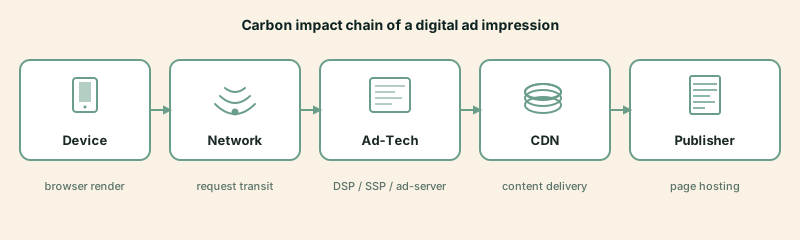
Every digital ad you encounter triggers a chain of energy use: the request travels through ad-tech platforms, content delivery networks, and finally renders in your browser. Most ad blockers hide ads at the browser layer — useful for personal experience, but they make the underlying carbon impact invisible to advertisers, agencies, and CSRD reporting.
Lumotraq takes the opposite approach. We measure the impressions you actually see, in your browser, in real time — turning what was a hidden cost into a visible, measurable, reducible Scope 3 advertising emission.
[IMG 1 placeholder — carbon impact chain diagram, recommended 1200×675 — replace this DivBlock with Image element in Designer once asset exists]
Lumotraq is the productive, carbon-conscious alternative to ad blockers — for individuals who want to see their digital footprint, and for advertisers and publishers who need audit-ready Scope 3 advertising data.
The 5-stage carbon chain of a digital ad — device → network → ad-tech servers → CDN → publisher
Lumotraq is deliberately scoped. Here's what the measurement covers today, and what isn't in scope yet.
In scope: display ads, video ads, social-media ads on major platforms, streaming-page ads, audio and podcast browser surfaces, in-game browser surfaces.
Out of scope: digital out-of-home (DOOH), connected-TV native apps, linear and broadcast television, print, brand-safety scoring.
1. Detect — Lumotraq's lightweight browser extension recognizes ad impressions across nine social and content platforms plus 603 publisher domains as you encounter them.
2. Locate energy intensity — for each impression, the local energy grid data is matched to your country at the moment the ad loaded.
3. Estimate delivery path — public ad-tech infrastructure benchmarks are applied to model the energy used between the ad-tech request and your browser.
4. Calculate — the per-impression CO₂e is computed in grams and stored against your Score.
5. Aggregate — impressions are grouped into channels, campaigns, and a personal Score so you can see where emissions concentrate.
6. Export (B2B tiers) — audit-ready Scope 3 advertising data is exported in formats accepted by CSRD reporting tools.
Lumotraq's measurement flow — Detect → Map → Quantify → Report
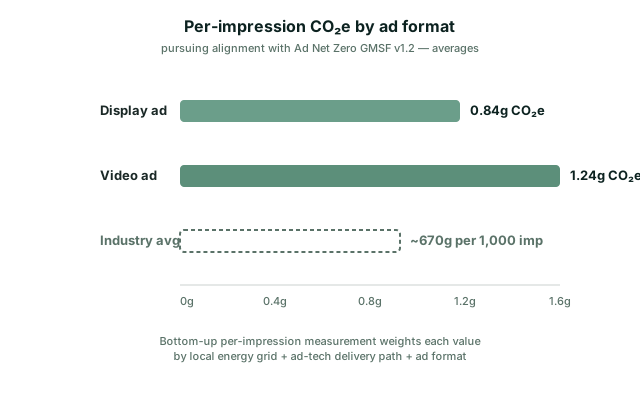
A single display ad emits roughly 0.84g CO₂e and a video ad about 1.24g. These are averages aligned with Ad Net Zero's Global Media Sustainability Framework — actual values depend on the energy grid where the impression was served, the ad-tech delivery path, and the ad format itself.
[IMG 2 placeholder — per-impression CO₂e comparison chart, recommended 600×400 or 800×500 — replace this DivBlock with Image element in Designer once asset exists]
0.84g display + 1.24g video — per-impression baseline values
Lumotraq combines three classes of public data with its own real-time browser detection:
Public European energy grid data covering 39 countries with five years of monthly historical averages — powers the energy carbon-intensity calculation per impression at the time it loaded.
Public IAB Tech Lab and industry benchmarks — used to model the delivery-path efficiency from ad-request through to the user's browser.
Lumotraq's own lightweight detection running entirely in your browser — captures the actual impressions seen, never the underlying device, never personal identifiers.
[IMG 3 placeholder — data sources geo or infographic, recommended 600×400 or 800×500 — replace this DivBlock with Image element in Designer once asset exists]
All measurements happen client-side in the browser. Lumotraq does not fingerprint devices, does not track personal identifiers, and does not transmit ad content to any server. Privacy-by-default is non-negotiable.
Three classes of data — public grid intensity + public infrastructure efficiency + real-time browser detection
Lumotraq's measurement is pursuing alignment with:
Ad Net Zero — Global Media Sustainability Framework
GHG Protocol — Scope 3 reporting framework for advertising emissions
IAB Tech Lab — measurement guidelines
Pursuing alignment with Ad Net Zero GMSF + GHG Protocol Scope 3 + IAB Tech Lab measurement guidelines
Three measurement approaches exist in the ad-carbon market today, each with different trade-offs for advertisers, agencies, and publishers.
Measures average CO₂e per ad format from public industry benchmarks. Best for small advertisers needing a directional estimate without ad-tech integration. The trade-off: it cannot reflect actual campaign-level efficiency.
Combines emissions estimated across ad-tech vendors via vendor cooperation. Best for large advertisers running campaigns across multiple DSPs and SSPs simultaneously. The trade-off: it requires every vendor in the chain to share data — opaque where they don't.
A licensed measurement framework resold under another brand. Best for agencies wanting a turn-key carbon report packaged with media buying. The trade-off: limited methodology customization and vendor-lock-in on the underlying data.
Each display or video impression measured within the user's browser environment, weighted by local energy grid data and the ad-tech delivery path. Best for advertisers, publishers, and individuals who want precise, audit-ready Scope 3 advertising figures. The trade-off: it requires a lightweight browser extension or publisher pixel for coverage.
Lumotraq is built on bottom-up impression-level measurement, pursuing alignment with Ad Net Zero's Global Media Sustainability Framework, the GHG Protocol Scope 3 reporting framework, and IAB Tech Lab measurement guidelines. The result is per-impression data your CSRD reporting team can defend and your business can reduce.
Bottom-up impression measurement vs the three top-down approaches — comparison matrix
Lumotraq detects display and video ad impressions as they load in your browser, then weights each impression by the local energy grid at that moment, the ad-tech delivery path, and the ad format. The result is a per-impression CO₂e value computed in real time — averaging 0.84g for display and 1.24g for video.
Scope 3 emissions are indirect CO₂ from a company's value-chain activities. For an advertiser, Scope 3 advertising covers the emissions of every ad impression their campaigns generate — across ad-tech intermediaries, publisher servers, content delivery, and the consumer's browser.
Lumotraq is pursuing alignment with Ad Net Zero's Global Media Sustainability Framework, the GHG Protocol Scope 3 reporting framework, and IAB Tech Lab measurement guidelines.
Three categories of input: public energy grid data covering 39 European countries with five years of monthly historical averages, public ad-tech infrastructure benchmarks, and Lumotraq's own real-time detection running inside your browser. The detection never fingerprints devices and never transmits personal identifiers — measurement is privacy-by-default.
Most ad-carbon measurement today is either top-down modeled (averages applied to all campaigns), supply-chain aggregated (depends on vendor cooperation across the ad-tech stack), or licensed from a single reseller. Lumotraq measures bottom-up per impression in the browser — each display and video ad you actually see, with local grid and delivery-path weighting. The result is audit-ready Scope 3 advertising data your CSRD reporting team can defend.