Every time you visit domains, a search result page or one social feed dozens of ads are served to your screen. Most are “viewable” by the industry's official definition: half the ad's pixels visible for one second. Far fewer actually capture your attention in the first place. Yet almost none of them carry a (carbon) footprint.
What if the standard your industry has bought against for twelve years has only ever been measuring whether ads got a chance, not whether they landed?
That question is rewriting digital ad measurement in general. Three layers are emerging — viewability, attention and environmental impact — each addressing a dimension the previous one missed.
What “viewable” actually means
The Media Rating Council (MRC) and Interactive Advertising Bureau (IAB) jointly defined the standard. A display ad is viewable when at least 50% of its pixels are visible on the user's screen for at least one continuous second. Video requires the same 50% threshold for two seconds with audio enabled.
That is the entire definition. It says nothing about whether the ad was noticed, processed, or remembered — only that it had the opportunity to be seen.
IAB Europe's Commerce Media Measurement Standards Version 2 publishedJauary 2026, tains 50%/1s as the baseline. The bar holds because programmatic billing needs a yes-or-no quality check. But twelve years after the MRC published its guidelines, retail media, connected TVand commerce platforms have all emerged — the bar that worked for desktop display in 2014 reads differently against them.
Your specific campaigns probably score viewability anywhere between 30% and 80%, depending on each placement and creative format. Those are vendor-reported, they are not "user-experienced". The spread tells you very little about whether your audience actually engaged or not.
Why 47% of advertisers stopped trusting viewability alone
In 2024, eMarketer's Attention Metrics Ecosystem report captured the shift directly: 47% of buy-side decision-makers expected their organisation to focus somewhat or significantly more on attention metrics — up from just over a third the year before. Within twelve months “attention” went from emerging vocabulary to mainstream measurement layer.
What attention measures, plainly, is whether the consumer noticed and absorbed the message — not whether the ad had the chance to be seen. Adelaide built an attention unit (AU) that scores placements from 0 to 100 and feeds into more than a dozen DSPs. Lumen's Attention Measurement Platform has trained on over 650.000 eye-tracking sessions. Amplified Intelligence brings panel data from 100.000-plus human subjects across 15 countries. Integral Ad Science (IAS) layers attention scores onto its existing viewability tags.
These vendors disagree on methodology. They agree on the principle: viewability is the floor, attention is the next layer.
The gap matters because viewability and attention diverge sharply. A placement can score 80% as "viewable" and 20% on attention. Those 60 percentage points are budget spent against an impression that technically met the standard yet practically failed to land.
Where you encounter ads matters more than viewability says
Newsworks' attention research, conducted with Lumen and effectiveness consultant Peter Field, compared ads on 12 news brand sites against the top 500 sites by impression volume in Lumen's UK dataset across 2023 and 2024.
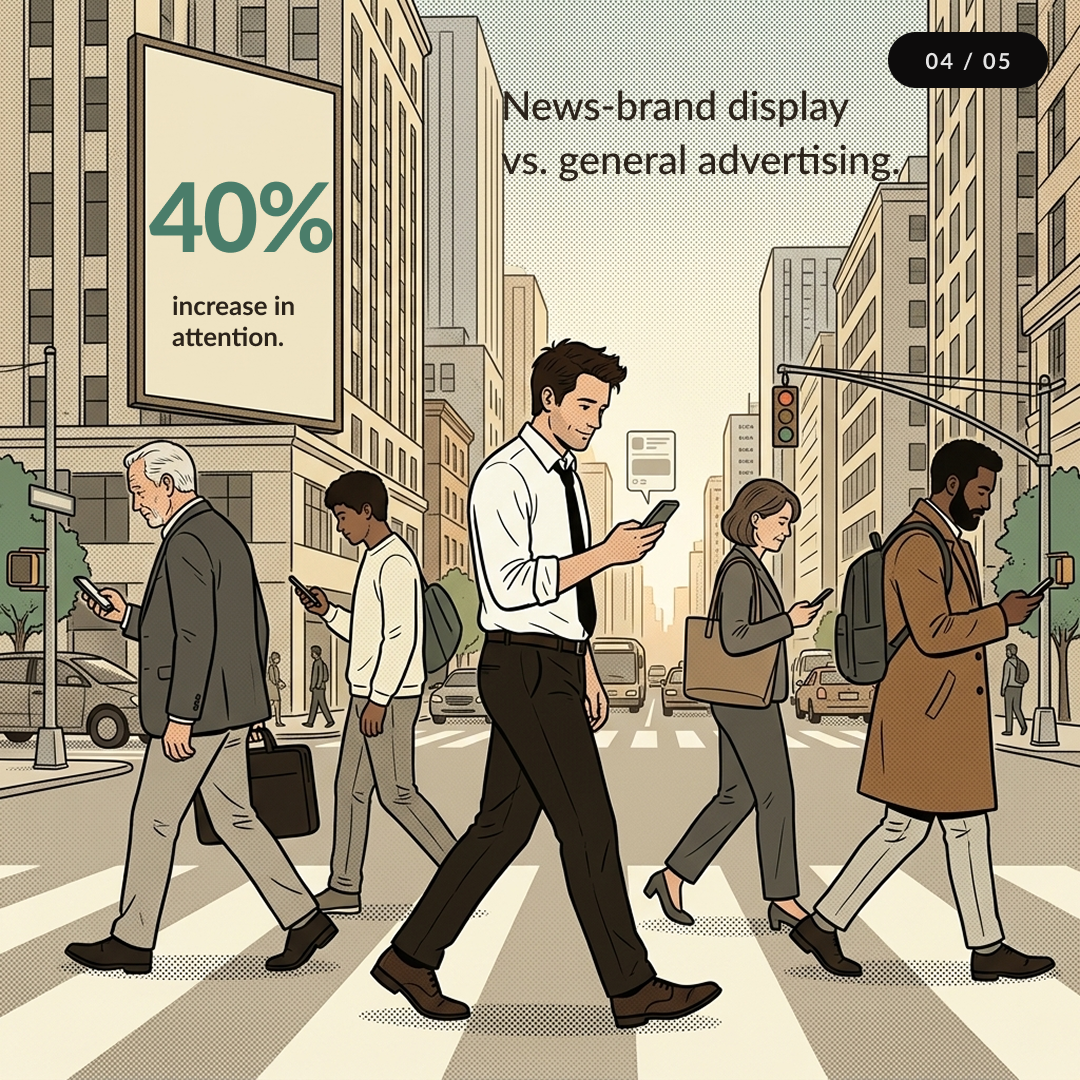
Display ads on news brand sites generated 40% more attention than display ads on general advertising sites. Video ads on news brand sites generated 24% more than video elsewhere. Behind the headline numbers: display dwell time was 2.13 seconds on news brands versus 1.63 seconds elsewhere (31% uplift); video dwell was 2.36 seconds versus 1.97 seconds (20% uplift).
The implication for media planning is direct: where an ad is placed matters as much as who sees it. The same creative running on a news brand environment captures meaningfully more attention than running across general programmatic inventory - not a standard web crawler learning with AI.
Newsworks frames this as a structural argument for moving budget toward high-attention media — they recommend news brands should represent at least 10% of any digital plan to deliver effectiveness growth. Whether you accept the prescription or not, the underlying finding is clear: your specific publisher mix changes attention rates dramatically. Aggregate benchmarks are starting points, not answers.
What measurement layer comes next
The same logic that produced attention as viewability's successor is producing the next dimension: environmental measurement.
Viewability tells advertisers an ad had the chance to be seen. Attention tells them whether it was processed. Neither says anything about what the impression cost the environment. As of 2025, the EU's Corporate Sustainability Reporting Directive (CSRD) requires thousands of companies to report Scope 3 emissions — and digital advertising is increasingly recognised as a material contributor. The measurement layer is forming. IAB Tech Lab's Sustainability Working Group is coordinating industry alignment. Specialised vendors are building the per-impression measurement infrastructure that did not exist three years ago.
Lumotraq operates in this environmental impact layer. The browser extension measures the ad carbon footprint of every impression served across whitelisted publisher domains — surfacing the dimension that neither viewability nor attention captures.
The practical move for 2026. Add one missing layer at a time. Already measuring attention? Add carbon emissions. Buying primarily on viewability? Move to attention first. The measurement stack is evoling — viewability, attention, environmental impact — is where ad measurement is converging.